Blog / Website planning
Website Designer vs. DIY Website Builder: Which Is Right for Your Business?
An honest look at both routes, including when building it yourself is the smarter choice.

By Zack Lekas · · 3 min read
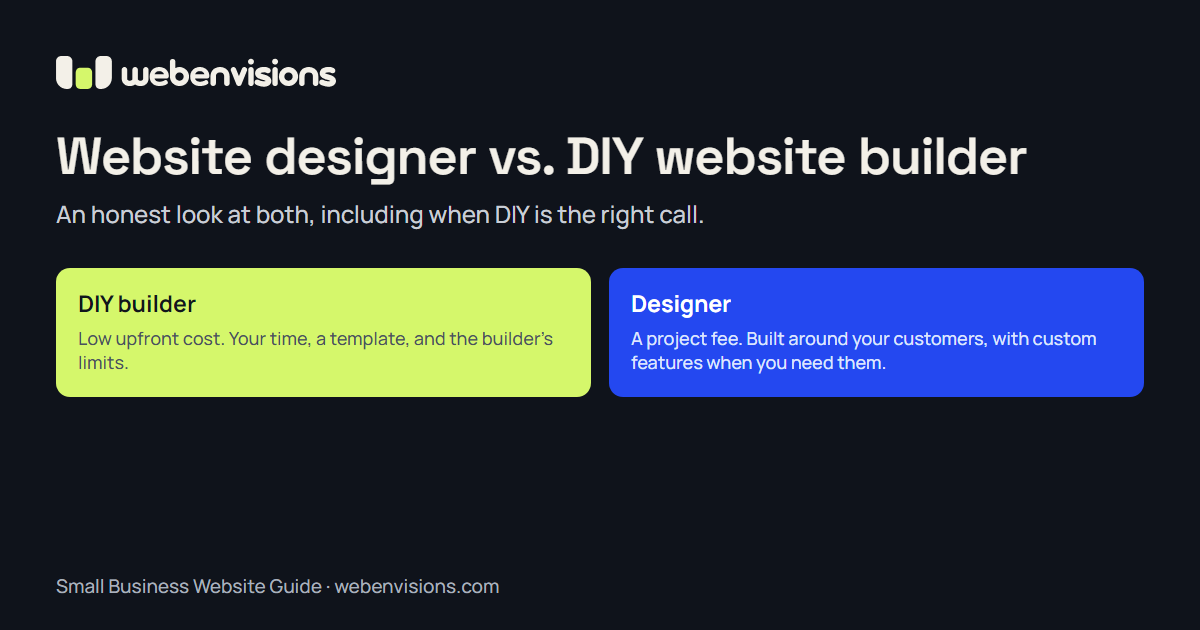
You can build a perfectly good small business website yourself. You can also lose months and customers trying. Which one happens depends less on your skills than on what your website needs to do.
This article compares the two routes honestly. It’s part of my Small Business Website Guide.
The two routes
A DIY website builder, like Squarespace, Wix, or Shopify, gives you templates, hosting, and an editor for a monthly or yearly subscription. You choose a design, write the content, and set everything up yourself.
A website designer or developer plans, designs, and builds the site for you, usually for a project fee, with ongoing care available after launch. Some build on those same builders; others build custom sites.
Side by side
| DIY builder | Designer or developer | |
|---|---|---|
| Upfront cost | Low: a subscription | Higher: a project fee |
| Your time | High: you do everything | Low to moderate: you supply knowledge and feedback |
| Speed to launch | Fast if you know what you want | Depends on scope and schedules |
| Design | Template-based | Built around your business and customers |
| Custom features | Limited to the builder’s apps and plans | Whatever the project needs |
| Search setup | Basic tools; you configure them | Should be included, along with redirects from an old site |
| Ongoing changes | You make them | You can, or pay for help |
| Ownership and moving | Tied to the builder’s platform | Depends on the platform; ask before you start |
When DIY is the right choice
Building it yourself makes sense when:
- You’re just starting out and need something online quickly and cheaply.
- You offer one or two simple services with clear prices.
- You enjoy this kind of work and have the time for it.
- A template that’s close to what you need already exists.
- The site mainly needs to be found and give people a way to call or email.
A clean, simple DIY site that answers customers’ questions is much better than no site, or an expensive one that never launches.
When hiring someone pays off
A designer usually earns their fee when:
- Your website is a main source of customers, so small improvements in how many visitors get in touch add up to real money.
- Customers need help choosing, between several services, packages, or products, and a template’s generic layout doesn’t guide them.
- You need custom features, like a quote calculator, booking with your own rules, a product finder, or integration with tools you already use.
- You’re replacing an existing site that ranks in search, and need old page addresses redirected so you don’t lose that traffic.
- Your time is worth more running the business than learning web design.
- You’ve tried DIY and the site isn’t bringing in inquiries.
Questions to ask either way
- Who owns the domain name? It should always be you.
- Can you move the site later, and what would that involve?
- How will you update prices, photos, and services?
- What does it cost per year to keep running, including add-ons?
- How will you know whether it’s working, like inquiries, calls, or bookings?
A middle path
It doesn’t have to be all or nothing. Some businesses start with a DIY site and hire help for specific pieces: a better service page, a booking integration, faster loading, or a redesign once the business has grown. Others have a designer build the site and then make everyday updates themselves.
To see what each route might cost, read how much a small business website costs. If an existing site is the question, when to redesign your business website helps you decide between fixing and rebuilding.
If you’d like help
I build custom websites for small businesses, and I also fix and extend sites you already have; a rebuild is only suggested when it’s really the better option. If you’re not sure which route fits, tell me about your business.
All postsNext: When Should You Redesign Your Business Website?