
Blog / Website planning
Do Small Businesses Need a Custom Website?
Often the answer is no, not yet. A template or builder covers a lot. Here are the five signs that a custom site has become worth the money.

By Zack Lekas · · 3 min read
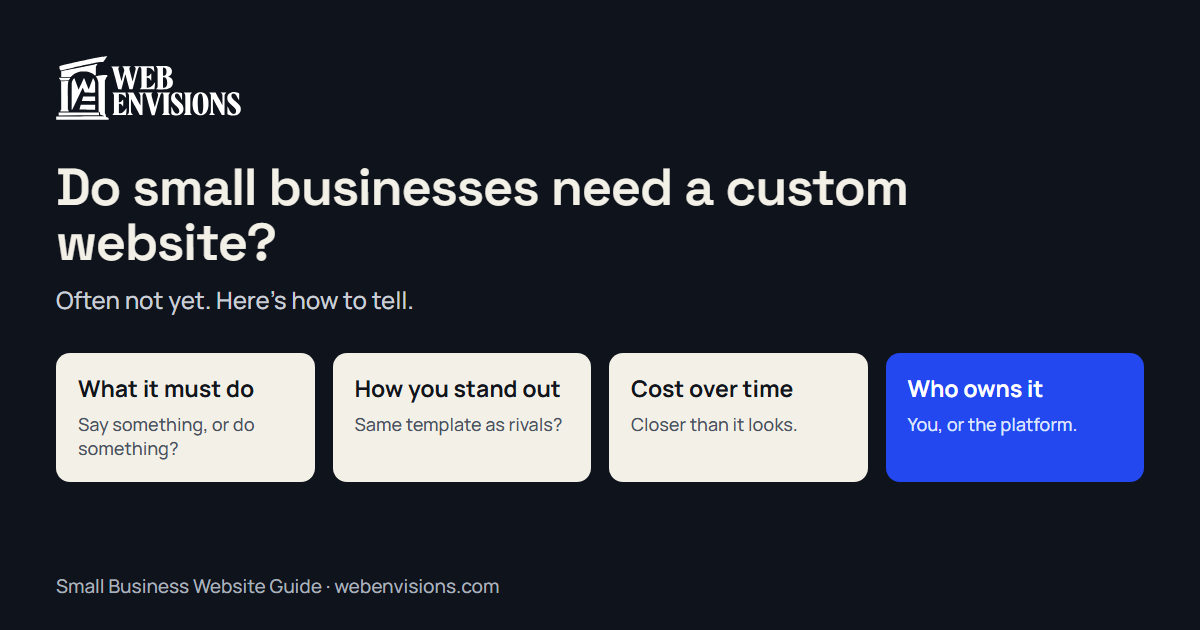
I build custom websites for a living, and my honest answer to this question is: often not, or not yet. A lot of small businesses are well served by something simpler. Here’s how to tell which side you’re on.
What “custom” actually means
A custom website is designed and built for one business. The pages, what each one does, and how it looks are decided for you.
The alternatives are a website builder you set up yourself (Squarespace, Wix), or a template someone sets up for you. Both start from a design that already exists.
“Custom” doesn’t mean better-looking. Plenty of template sites look excellent. It means the site was made to fit, including the parts that do something.
When you don’t need one
- You’re new. You don’t yet know which services sell or what customers ask. Learn that on something cheap.
- Your site’s job is to inform. What you do, where, proof, phone number. A template does this well.
- Customers come by referral and only check the site to confirm you’re real.
- Money is tight. A few thousand dollars may do more for you in equipment, a truck wrap, or a slow month’s cushion.
If that’s you, start with a builder or a template built for you. Website template vs. custom website compares the two, and website designer vs. DIY website builder covers doing it yourself.
Five signs a custom site will pay for itself
1. The site needs to do something a template can’t. Take a request that changes its questions by job type. Work out a price from your own rules. Book against your real calendar. Connect to the software you run.
2. You’re fighting your current site. Small changes take an evening of workarounds, or can’t be done at all.
3. You look like your competitors. In a crowded local market, three businesses on the same template blur together.
4. The site is a real source of work. If a meaningful share of your jobs starts online, small improvements in how it converts are worth real money.
5. You want to own it outright. No platform, no subscription that holds the design.
One sign is a reason to think about it. Two or more, and it’s worth pricing.
The cost, honestly
Using my own prices as the example: a custom Starter site is $2,500 to $4,000 and a Standard site is $5,000 to $9,000. A template built for you is from $119 a month. A builder you set up yourself is a subscription of tens of dollars a month, plus your time.
Over a few years the totals are closer than the up-front numbers suggest. What differs is when you pay, what the site can do, and what you own at the end. How much does a small business website cost? breaks it down.
A sensible path for most businesses
- Start simple. A builder or template, with real photos and clear words.
- Watch what happens. Which pages people use, what they ask, where they get stuck.
- Go custom when a sign above shows up, and build around what you learned.
The first site isn’t wasted. Its words, photos, and domain carry over, and it told you what the second one needs.
The test in one question
Does your website need to do something, or only say something?
If it only needs to say something, you probably don’t need custom yet. If it needs to do something, such as quote, book, guide, or connect, that’s when custom earns its cost. Static vs. interactive websites goes deeper on that line.
If you want a straight answer for your business
I’m Zack at Web Envisions in Bend. Tell me what you do and what you want the site to bring in, and I’ll tell you whether I’d go custom, including when the answer is no. Small business web design shows all three options side by side.